Welcome back to Kovolution! 🥢🌾
When international travelers think of quintessential Korean food, rich barbecues, fermented kimchi, and fiery stews often steal the spotlight. However, to truly understand the soul of Korean comfort food, one must explore the rustic, mountainous regions of Gangwon-do. Here, amidst towering granite peaks and crisp highland breezes, thrives an ancient grain that has nourished the Korean people through centuries of bitter winters: Buckwheat (Memil / 메밀).

Today, we journey to the spiritual heartland of Korean buckwheat—Bongpyeong, Pyeongchang—to explore Bongpyeong Migayeon (봉평 미가연).
This traditional tile-roofed restaurant is helmed by Grand Master Oh Sook-hee (오숙희 명인), a nationally and globally certified culinary master holding prestigious food patents for her buckwheat noodle craftsmanship. Famed across South Korea and personally visited and praised by culinary heavyweights such as Iron Chef winner Edward Lee on national television, Migayeon introduces diners to a rare, exquisite Korean delicacy: Tartary Buckwheat (Sseun-memil / 쓴메밀).
Let’s dive into the history, science, culture, and sensory delight behind Korea’s ultimate buckwheat noodles!
Chapter 1. Roots in the Mountain Soil: The Historical Origin of Korean Memil
Buckwheat’s relationship with Korea stretches back over a millennium. Believed to have arrived on the Korean Peninsula via northern trade routes during the Goryeo Dynasty (918–1392), buckwheat quickly established itself as an indispensable survival grain (Guhwang-jakmul / 구황작물).
The geographic terrain of the peninsula—particularly the rugged mountains of Gangwon-do—was too steep, rocky, and cold for reliable white rice farming. Buckwheat, however, possessed an extraordinary resilience: it could grow in poor soil, mature in as little as 70 to 80 days, and withstand cold mountain frosts. Whenever droughts or monsoons wiped out primary rice crops, farmers sowed buckwheat to stave off famine.

Historically, cold buckwheat noodles—known broadly as Makguksu (막국수), translating directly to “noodles made roughly/just now”—became a winter staple. Because buckwheat lacks gluten, the dough had to be mixed with cold water, pressed immediately through wooden presses directly into boiling water, and rinsed in freezing streams. It was traditionally eaten late at night during harsh mountain winters, often submerged in chilled winter radish water kimchi (Dongchimi). Over generations, this humble peasant food evolved into one of Korea’s most treasured national dishes, transitioning into an indispensable refreshing summertime treat loved by millions today.


Chapter 2. Sweet vs. Bitter: The Revolutionary Art of Tartary Buckwheat
Most buckwheat noodles served across East Asia (such as Japanese Soba or standard Korean Naengmyeon) are made from Sweet Buckwheat (Dan-memil / 단메밀). However, Master Oh Sook-hee made it her life’s missio to pioneer the revival of Tartary Buckwheat (Sseun-memil / 쓴메밀 – Bitter Buckwheat).
Tartary buckwheat is an ancient highland grain containing up to 70 to 100 times more Rutin—a powerful antioxidant flavonoid that supports cardiovascular health and blood pressure regulation—than common buckwheat. Yet, throughout culinary history, chefs avoided it because it is notoriously difficult to process, brittle to knead without wheat binders, and imparts a distinct, herbal bitterness.

Through decades of research at her Bongpyeong Buckwheat Food Culture Research Institute, Master Oh earned formal patents for her proprietary technique of blending pure Tartary buckwheat with sweet buckwheat flour and cold-water kneading. The result is a noodle with structural elasticity that retains 100% of its pure grain character, transforming natural grain bitterness into an addictive, clean, nutty undertone that cannot be tasted anywhere else on earth.
Chapter 3. Visual Poetry in a Deep Blue Bowl: The Noodle Presentation
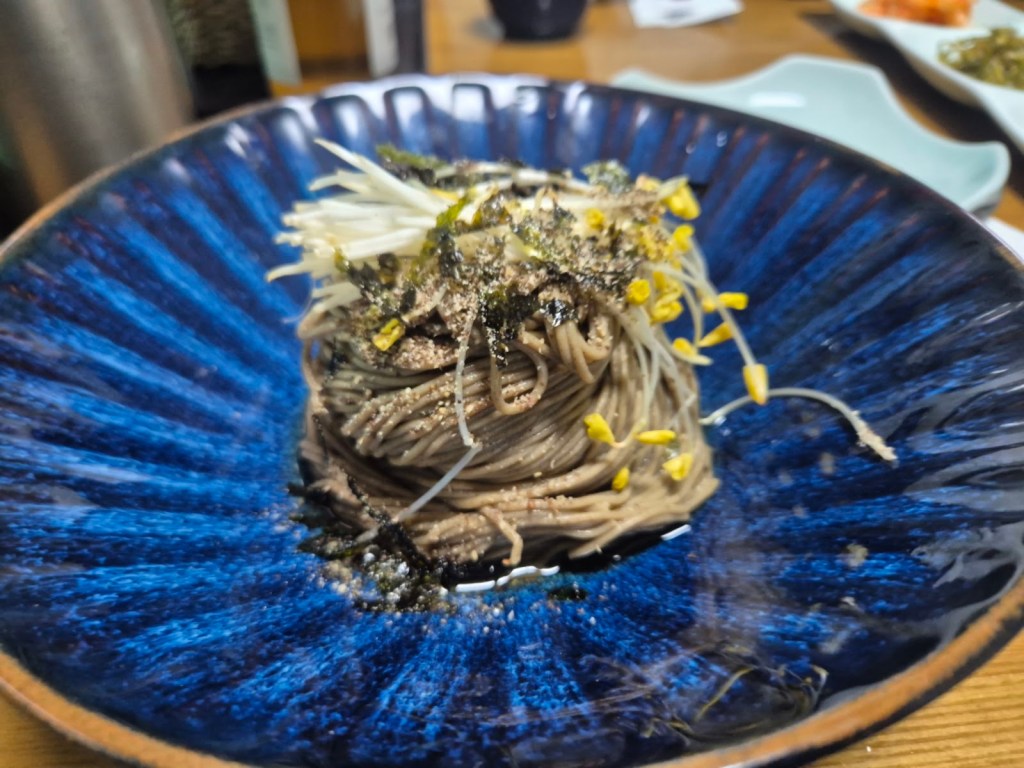
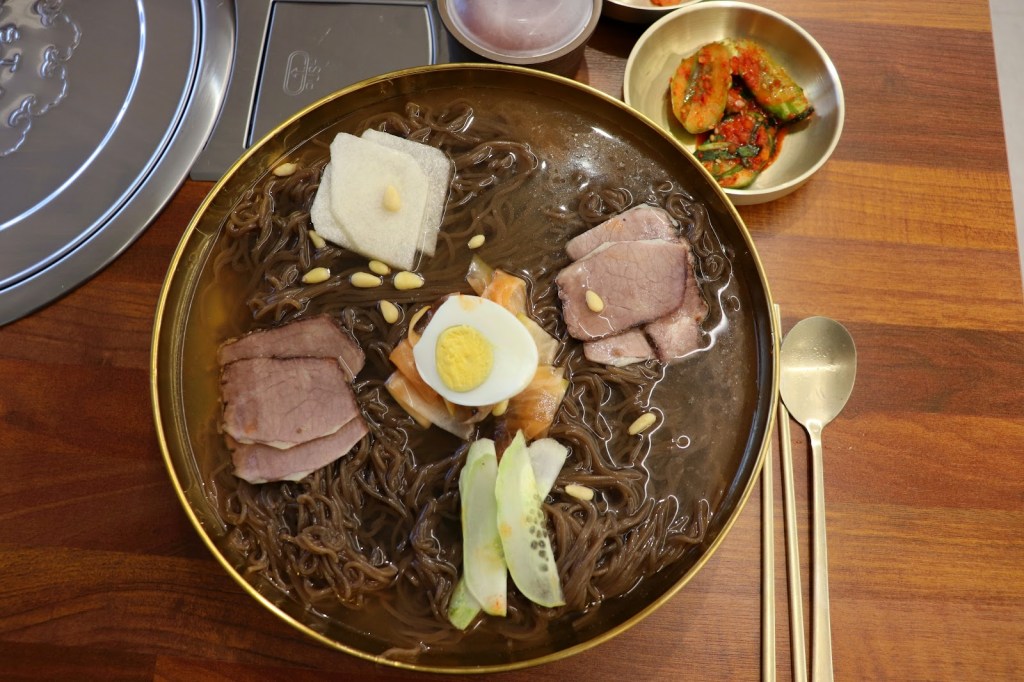
When your order arrives at Migayeon, the visual presentation commands immediate respect. Rather than a messy, rustic heap, the noodles are styled with fine dining restraint.

The dish is presented inside a wide, radiating deep-blue ceramic bowl reminiscent of a blooming night flower. At the center sits a tightly coiled bundle of grey-brown buckwheat noodles, proudly displaying the dark flecks of freshly milled grain hulls.

Resting atop the noodles is an artful crown of young yellow-tipped buckwheat sprouts (Memil-ssak / 메밀싹), shredded dried toasted seaweed (Gim), and a fragrant dusting of roasted perilla seeds and wild sesame powder. The slender, pale green sprouts provide an energetic crunch and a delicate vegetal sweetness that immediately complements the deep earthiness of the noodles.
Chapter 4. The Flavor Journey: Bitter Nuance and Refreshing Broth
Tasting these patented noodles is a multi-layered sensory adventure that completely shatters expectations for international diners accustomed to standard wheat pasta.
Lifting a mouthful of noodles reveals a texture that is rustic and tender, yielding with a clean, satisfying snap rather than a rubbery chew. When chewed dry, the initial taste is deeply toasty and nutty, followed by a faint, sophisticated pleasant bitterness—a clean, herbal finish that coats the palate and cleanses your tastebuds.
The dish is served alongside an individual bowl of chilled, semi-frozen broth seasoned with finely minced cucumbers and traditional aromatics. Spooning this cold, savory elixir over the noodles or dipping the noodles into the broth transforms the dish entirely. The cold acidity and savory umami of the broth meld effortlessly with the bitter perilla-coated noodles, creating a harmonious sweet-savory-bitter equilibrium that famous chefs like Edward Lee have praised as an unforgettable culinary awakening.


Chapter 5. The Gentle Companion: Traditional Buckwheat Crepe (Memiljeon)
While the cold noodles stand as the crown jewel, no authentic meal in Bongpyeong is complete without ordering a plate of warm Memiljeon (메밀전 – Buckwheat Flatbread).

This traditional Gangwon pancake is griddled paper-thin from a smooth buckwheat batter, layered delicately with whole stalks of sweet mountain green cabbage and aged wild chives. Soft, velvety, and entirely ungreasy, rolling a warm slice of this earthy pancake and dipping it into light seasoned soy sauce provides a gentle, soothing contrast to the cold, brisk noodles.
📌 Editor’s Note: The Untamed Soul of Gangwon on a Plate
If your South Korean travels take you through the alpine landscapes of Pyeongchang, reserving a table at Bongpyeong Migayeon is an absolute imperative. Validated by official culinary patents and the craftsmanship of Master Oh Sook-hee, this historic restaurant elevates a humble survival grain into pure high art. Experiencing the intriguing, noble bitterness of pure Tartary buckwheat noodles surrounded by crisp golden sprouts and cold, refreshing broth—complemented by a delicate, warm buckwheat cabbage crepe—delivers a profound, memorable connection to the resilient spirit and hospitality of Korea’s mountain heritage.



Leave a comment